Classification of Explosive Atmospheres

Classification of Explosive Atmospheres
CLASSIFICATION OF EXPLOSIVE ENVIRONMENTS: Explosive environments are classified according to explosion hazards and electrical or mechanical equipment selection is made according to this classification. The term ZONE in Latin and BÖLGE in Turkish r
The classification of explosive atmospheres is a process carried out to determine and prevent the risk of explosion that may occur during the use of electrical devices. Explosive atmospheres arise due to the presence of substances such as flammable gases, vapors, dusts, or fibers in the atmosphere. Any heat, spark, or high-energy devices that come into contact with these substances can cause an explosion.
The classification of explosive atmospheres is carried out in accordance with IEC/EN/ISO 60079-10-1 and NEC 500/505 standards. These standards define the methods and criteria used in the classification of explosive atmospheres.
The classification of gases and vapors is done according to three different zones: Zone 0, Zone 1, and Zone 2. Zone 0 refers to environments where explosive gases or vapors are continuously present. Zone 1 refers to environments where explosive gases or vapors are not normally present but may occasionally occur. Zone 2 refers to environments where explosive gases or vapors are not normally present but may pose an explosion risk in exceptional cases such as leaks caused by faults.
The classification of dusts and fibers is done according to two different zones: Zone 20 and Zone 21. Zone 20 refers to environments where explosive dust is continuously present. Zone 21 refers to environments where explosive dust is not normally present but may occasionally occur.
The classification of explosive atmospheres plays an important role in determining precautions based on the explosion risk. For example, devices used in Zone 0 or Zone 20 environments must have special protection types such as Ex d, Ex e, or Ex i to operate safely despite the presence of explosive atmospheres. These protection types are provided by Exproof devices designed and tested in accordance with ATEX and NEC standards.

ZONE 0, 20: Device category to be used 1
ZONE 1, 21: Device category to be used 2
ZONE 2, 22: Device category to be used 3
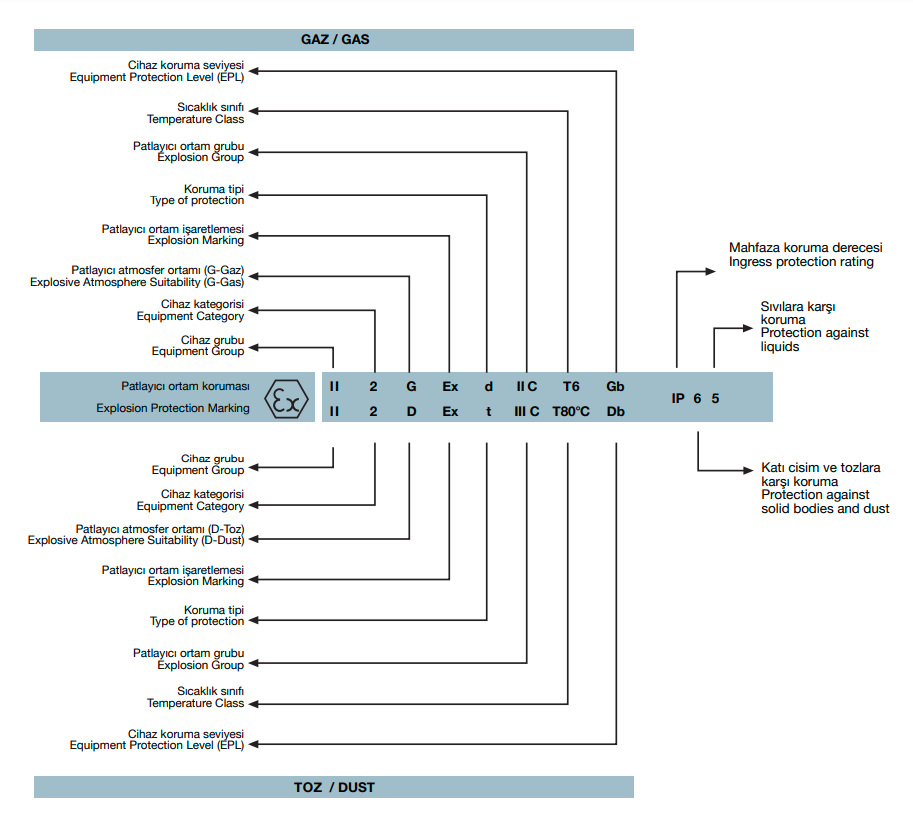
ATEX marking is a marking indicating that equipment used in explosive atmospheres complies with ATEX directives. ATEX is a directive established by the European Union and defines standards related to the manufacturing, sale, and use of equipment used in explosive atmospheres.
The ATEX marking starts with the "Ex" symbol and contains a series of letters and numbers that specify the protection type. The Ex symbol is the abbreviation for "Explosion" and is used in explosion protection equipment. The ATEX marking indicates for which types of explosive atmospheres the equipment is suitable and is provided by the manufacturer to ensure the equipment is used correctly.
The ATEX marking consists of two parts: the protection type and the equipment category. The protection type defines the type of explosive atmosphere in which the equipment can be used. For example, Ex d protection type is suitable for explosive gases and vapors, while Ex e protection type may be suitable for explosive dusts. The equipment category determines the equipment's resistance against explosion risk. Category 1 equipment has the highest level of explosion protection, while Category 3 equipment has the lowest level of protection.
The ATEX marking indicates that the equipment used in explosive atmospheres is safe and complies with the standards set by ATEX directives. Equipment with this marking is guaranteed to be safely used in explosive atmospheres and to minimize explosion risk.
In the zone system, explosive gases are represented by G and dusts by the letter D.
FLAMEPROOF DEVICE MARKING: